Critical Contours of Maithili Studies
Organised by Coralynn V. Davis, Christopher L. Diamond, and Pranav Prakash
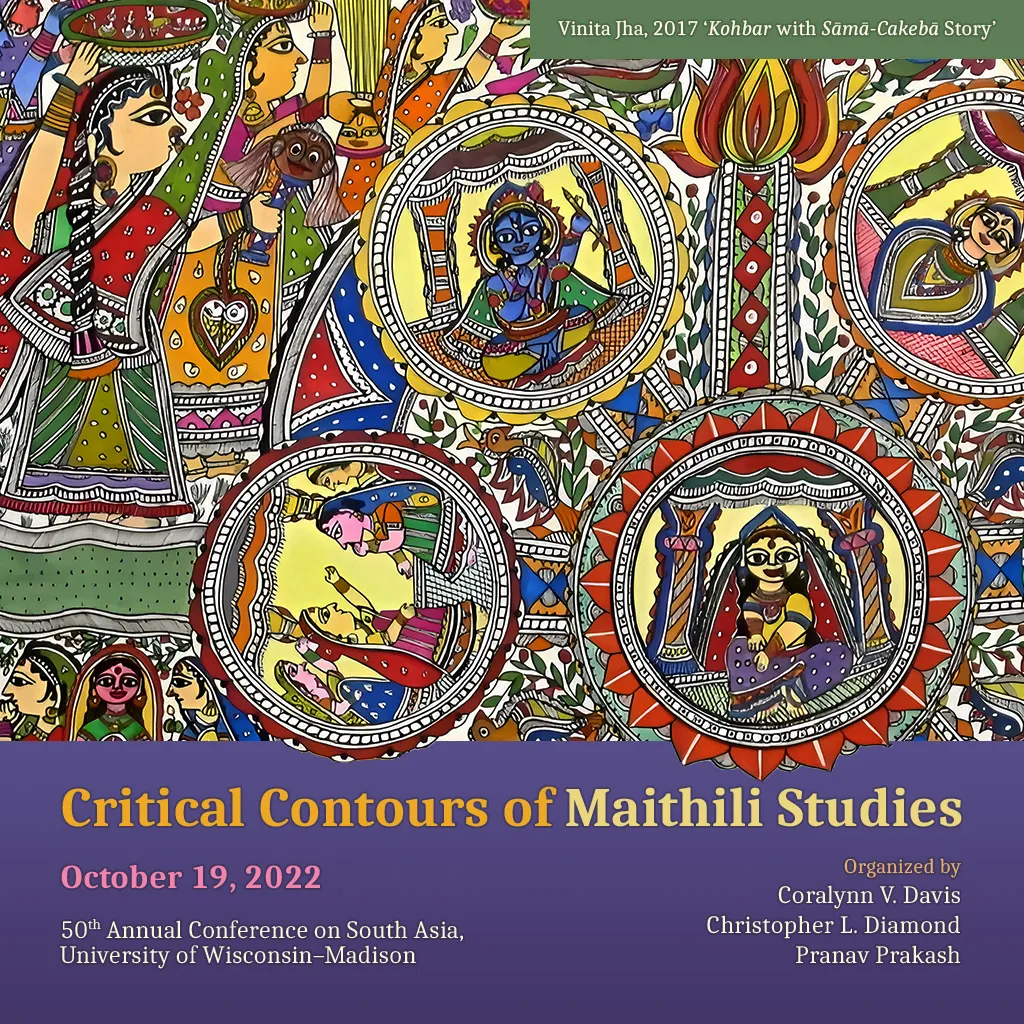
This symposium aimed to generate interdisciplinary conversations about the importance of contemporary scholarly study of Maithil society, culture and language. How has the study of Maithili-speaking peoples shaped humanistic inquiries and intellectual discourses locally and globally? From Alphabetum Brammhanicum (1771) to George Abraham Grierson (1851–1941) to Radhakrishna Choudhary (1921–1985), how has the study of Maithili cultures been framed by localized discourses about the region, its language(s) and people(s)? In turn, how has the academic study of Mithila outside of the region received, interpreted and framed these narratives? In light of its disciplinary past, can we envision new research agenda and methods for challenging hegemonies within the academy and in the wider society?
Although colonial-era missionaries and Orientalists took a keen interest in Maithili language, art and culture, the study of Maithili has not maintained the same academic focus in modern universities. Nevertheless, a variety of scholars from a range of disciplines have engaged in the study of Maithili and Mithila into the present. The field as it exists today is dominated by upper-caste, male scholars and littérateurs, who have privileged certain forms of historical knowledge production. Their engagement with Hindu philosophies and what they construed as “high-culture” has — in effect — marginalized contributions by Maithil women, lower-caste communities and religious minorities.
Against this backdrop, our symposium brought together an eclectic group of scholars, who reflected critically on the history, politics and future of Maithili Studies. This symposium was — to the best of our knowledge — the first ever attempt in the history of modern universities to evaluate the status, significance and prospects of Maithili Studies. Our symposium — both in framing its research agenda and in selecting its participants — remained steadfastly committed to the ethics of diversity, equity and inclusion.